Cooling Devices
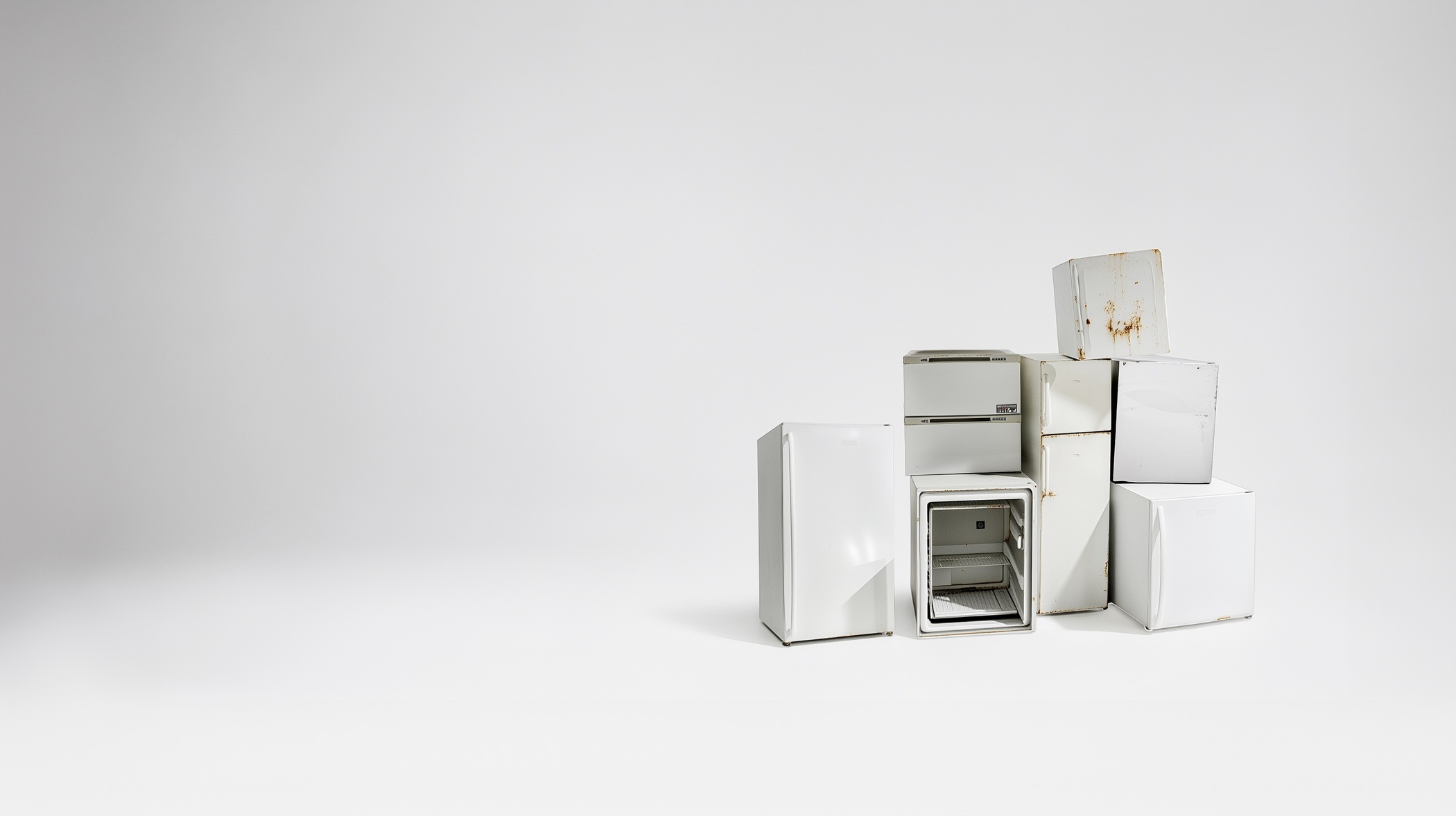
Modular Plant Concepts Adaptable to Various Input Streams
The recycling of cooling devices requires reliable depollution processes and controlled extraction of refrigerants, oil and blowing agents. These substances must be safely removed while enabling the efficient recovery of valuable secondary raw materials.
At the same time, the composition of cooling device streams is changing. Older appliances often contain halogenated blowing agents (VFC), while newer generations increasingly use halogen-free hydrocarbons (VHC) such as pentane or isobutane.
Our technologies enable both the treatment of mixed appliance streams and the efficient processing of devices containing exclusively VHC blowing agents. By combining robust mechanical processing with precise gas management and modular plant architecture, URT plants ensure reliable depollution, stable operating conditions and efficient recovery of secondary raw materials.
Facts and figures of our expertise
Years of experience in recycling plant engineering
End-of-life cooling devices plants delivered worldwide
Up to 4 tons per hour
Recovery of blowing agents and refrigerants (EN 50625 -2-3)
URT Plant Concept
URT cooling appliance recycling plants are designed as a two-stage treatment concept.
The first stage is always positioned upstream and is responsible for the extraction of oil and refrigerants.The second stage addresses the treatment of the appliance bodies and can be configured either as VHC selective treatment or VHC + VFC recovery, depending on the blowing agent recovery requirements.
Step 1
The exhausting process of cooling machine oil and cooling agent takes place by using drilling heads or piercing pliers. The cooling agent (VHC and/or VFC) exhausted will be liquefied under pressure and will get to a collection tank. The plant is designed to dispose flammable (VHC) and non-flammable (VFC) cooling agents of any proportion. An integrated oil post-treatment (heating and surface expansion) system ensures that the required residual value of 0.2 % halogen will drop below in any case.

Step 2
URT offers two complementary processconcepts for the recycling of coolingdevices. Both are based on proven engineering solutions and can be configured according to the composition ofthe input material and the operationalrequirements of the plant operator.
VHC Selective Recycling
The process combines defined size reduction, material separation and controlled handling of volatile compounds, together with a simplified gas treatment concept.
A key element is the automated identification of blowing agents using robotics. Openings are created in the cabinet and doors, gas samples are taken and analysed, and each appliance is assigned to the appropriate treatment process.
As no halogenated substances are present, hydrocarbons are treated directly in a thermal oxidation unit.

Process Characteristics
- Analytical identification of blowing agents prior to processing
- Selective treatment of halogen-free (pentane) cooling devices
- Direct thermal treatment of released hydrocarbons
- Explosion protection by air dilution up to 10.000 qm³ per hour
- Reduced or no inert gas demand compared to recovery systems
- Simplified process architecture for hydrocarbon-based appliances
Operational Advantages
- Explosion suppression through controlled gas dilution by redundant LEL measurement
- Lower energy consumption compared to combined recovery systems
- Energy recovery from VHC blowing agents by off-gas heat utilisation
- Reduced operating costs through simplified gas treatment
- Optimized process configuration for modern appliance streams
- No need of external disposal for blowing agents
VHC + VFC Recovery Recycling
The process combines gas-tight size reduction, material separation and controlled handling of volatile compounds with a blowing agent recovery system.
Blowing agents released during shredding and matrix degassing are extracted and routed through dust filtration and water pre-separation before entering activated carbon adsorption.
The activated carbon is regenerated by thermal desorption using superheated steam. The released blowing agents are condensed and separated from process water in a multi-stage system.

Process Characteristics
- Activated carbon adsorption system for blowing agent capture
- Steam desorption for regeneration of the adsorption beds
- Condensation and multi-stage separation of blowing agents
- Raw gas volume flow of approx. 1,500 m³/h
- Recovery rates of >90 % according to DIN EN 50625-2-3
- Blowing Agent recovery has an electrical connected load of approx. 115 kW
- Designed for continuous three-shift industrial operation
Operational Advantages
- Reliable recovery of halogenated and halogen-free blowing agents
- Compliant treatment of heterogeneous appliance streams
- Stable process performance under varying input conditions
- Proven adsorption technology with low maintenance requirements
- Robust design for long-term industrial operation
.svg)
Project Insight: VHC Selective Recycling with Robotic Blowing Agent Detection
Founded in 2006 in Lublin, PKR Polska is one of Poland’s leading companies in the treatment and recycling of waste electrical and electronic equipment. With a strong focus on innovative recycling technologies and the circular economy, PKR operates modern processing facilities for a wide range of electrical and electronic equipment.
Our cooperation with PKR has been characterized by mutual respect, open communication and a strong partnership from the very beginning. We greatly value the trust PKR has placed in URT as its technology partner and look forward to continuing our successful cooperation.
Shredding Technology
Mechanical shredding forms the core of the recycling process. Cooling devices are dismantled and mechanically processed, releasing insulation foam and preparing the material stream for downstream separation.
Lock System to Minimize Emissions
Cooling devices are fed into the shredding units through a multi-stage lock system. Each appliance passes through several lock chambers before entering the shredding environment. This prevents any direct connection between the shredding chamber and the surrounding atmosphere and minimizes diffuse gas emissions.
URT uses robust four-shaft rotary shears for pre- and post-shredding. The shredders are equipped with perforated sieves defining the output particle size and supporting the separation of polyurethane insulation foam from metal and plastic components.The cutting units operate at low rotation speeds of approximately 25 min⁻¹, reducing dust formation and minimizing explosion risks.
Gas Monitoring and Explosion Protection (VHC + VFC Recovery)
During shredding, released blowing agents are continuously monitored. Pentane concentrations are measured and nitrogen injection is automatically regulated depending on gas concentration.This demand-oriented system supports explosion protection while minimizing nitrogen consumption.
Four-Shaft Rotor Shear Technology
URT uses robust four-shaft rotary shears for pre- and post-shredding. The shredders are equipped with perforated sieves defining the output particle size and supporting the separation of polyurethane insulation foam from metal and plastic components.The cutting units operate at low rotation speeds of approximately 25 min⁻¹, reducing dust formation and minimizing explosion risks.
Advantages
- Robust cutting tools and machine structure
- Low rotor rotation speeds reducing dust formation
- Four-shaft rotor configuration for stable shredding performance
- Knife replacement without dismantling motors or gears
- Knife replacement after 200.000 fridges

Compliance
URT cooling device recycling plants are designed in accordance with relevant European standards including:
- EN 50625
- TA Luft and ABA-VwV
- BVT or BAT according to EU 2018/1147
- DIN/EN 50625
Boiler

Sandwich Panels

Supermarket Freezers

Commercial Fridges

Peltier Elements

Bogdan Ene
Operations Manager
GreenWEEE International S.A.

Services
We consult about, plan and build cooling devices recycling plants – tailored to our customer’s business objectives and in compliance with local regulatory requirements.
Engineering and Commissioning
1.
Engineering
Every successful project is based on a thorough analysis of material flows, site conditions and all technical, economic and regulatory requirements.
More information2.
Design
We design efficient, safe and durable recycling plants tailored to the input materials and individual objectives.
More information3.
Commissioning
Manufacturing, installation and commissioning are handled by experienced specialists, followed by operator training to ensure safe, efficient and autonomous operation from day one.
More information
Maintenance and Upscaling
4.
After Sales & Support
Dedicated specialists provide on site and online maintenance, technical support, process optimisation and global spare parts supply to ensure high plant availability.
More information5.
Shredding Tech. & Cutting Units Support
We provide servicing and replacement of shredder cutting units, including rental solutions with short lead times.
More information6.
Further Consulting & Upscaling
We future proof recycling plants through strategic scaling, plant extensions and technical consulting for future requirements.
More information

Efficient recycling starts with the right plant.
Contact us for an initial consultation regarding your specific requirements.